
When trees can no longer cool themselves
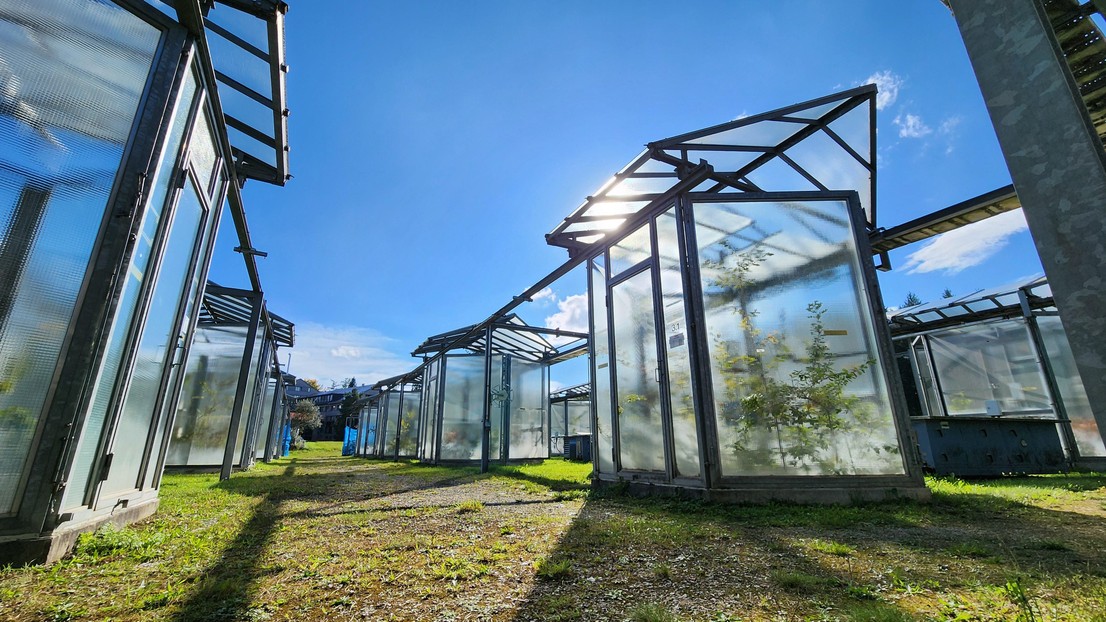
Greenhouses at WSL, at the Modoek facility © 2025 Alyssa Therese Kullberg / EPFL / WSL.
For five years, biologists subjected trees to prolonged drought conditions by reducing soil moisture, while also exposing them to experimental warming. Their findings show that trees can tolerate heat as long as sufficient water is available. However, under water stress, they lose their ability to cool themselves, which significantly increases their vulnerability.
When temperatures start to climb, trees must keep their leaves cool. Water is channeled up from the roots into the leaves where it evaporates through tiny pores called stomata. This lowers the surface temperature of the leaves through a cooling mechanism similar to sweating in humans. But when the ground is very dry, less water is available for the tree to absorb and circulate up to the leaves. The stomata respond by closing so as to conserve water within the tree – but that means the transpiration process no longer works as it should. The leaves cannot cool off and their temperature can rise quickly, especially during heatwaves and when the tree is under direct sunlight. This triggers what is known as a hydraulic and thermal cascade.
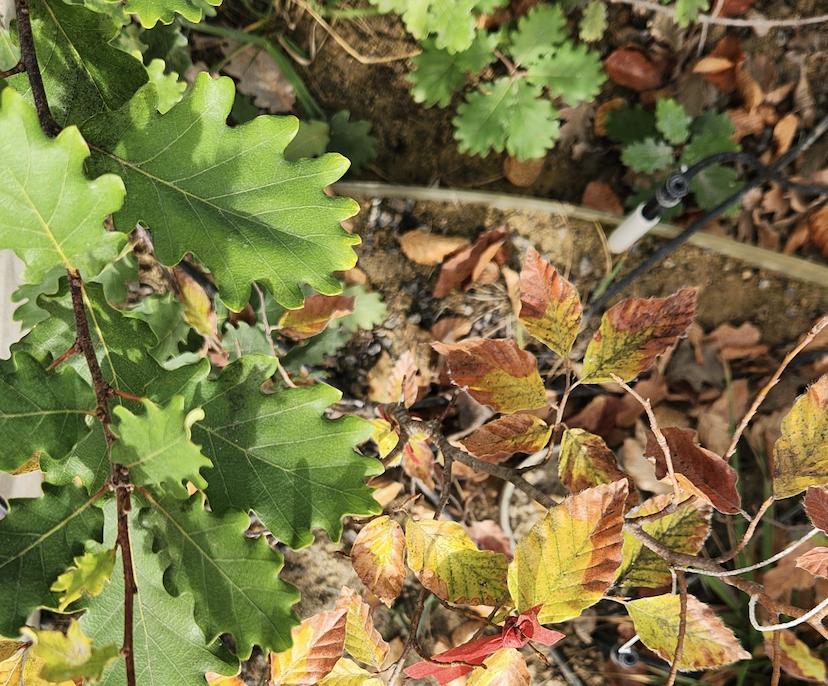
The team of biologists from EPFL and the Swiss Federal Institute for Forest, Snow and Landscape Research (WSL) in Birmensdorf subjected young European beech and downy oak trees to hot, dry conditions. They used greenhouses at WSL's Modoek facility (see box at the end of the text for more information), where both soil moisture and air temperature can be carefully controlled. The trees were exposed to air temperatures as much as 5°C above normal and had access to less water. These tree species were selected because they are important to Central Europe’s economy. “Downy oak grows mainly in Mediterranean areas but is also found in Switzerland. We wanted to compare its water-use strategy with that of the beech, a tree more sensitive to droughts, especially in the sapling stage,” says Alyssa Therese Kullberg, a scientist at EPFL’s Plant Ecology Research Laboratory who has long studied this process.

© 2025 Alyssa Therese Kullberg / EPFL / WSL.
Sunburn and scorching
The study aimed to examine how trees adapt to dry weather and extreme heat, and what factors are at play when tree leaves become dehydrated, lose their ability to cool off or even become scorched. “We looked specifically at the trees’ thermoregulatory response,” says Kullberg. “Leaves in the canopy are directly exposed to sunlight and can become up to 10°C hotter than the ambient air, reaching temperatures of 40–45°C, which is higher than what we typically observe in Central Europe. Despite this level of heat, the thermoregulatory response usually works normally. We might sometimes see a little sunburn on the leaves with minor damage to the photosynthesis system, but that damage is usually temporary. "The real difference appeared in the longer-term effects on the leaves. “We didn’t see much scorching on oak leaves, even though its thermal safety margins were exceeded roughly as often as those of beech,” says Alyssa Therese Kullberg. “In other words, both species reached critical temperatures with similar frequency, but the oak seemed better able to tolerate those conditions. This unexpected difference isn’t fully explained by the mechanisms we measured in our study.”

and physiological responses of plants to environmental stresses, such as drought.
© 2025 Alyssa Therese Kullberg / EPFL / WSL.
The researcher found certain trade-offs taking place within trees. When subjected to high temperatures alone, the trees get close to the hydraulic safety margin – beyond which there’s no longer enough water present to prevent wilting. Individual trees allow just enough water to evaporate to keep their leaves cool while staying inside the safety margin. But when subjected to high temperatures combined with dry soil, the amount of water required for the cooling mechanism to work is far higher. The water is used up more quickly and the stomata end up closing – regardless of whether the leaves needed to cool off – and the mechanism breaks down. As a result, the leaves become both dehydrated and too hot.

This tree is undergoing a combined heat and drought treatment.
© 2025 Alyssa Therese Kullberg / EPFL / WSL.
“Our experiments proved that if leaves go beyond the thermal safety margin – meaning they go into a thermal danger zone – and are subject to drought conditions at the same time, the leaves begin to experience permanent damage in the form of scorching,” says Kullberg. “This is an important finding because that link had never been so clearly established with experimental data. So we’re really excited about this discovery.”
It may seem surprising that such a link had never been demonstrated before. But that’s largely because it’s a real challenge to measure leaves’ temperatures with sufficient temporal resolution to be able to say that a given leaf reached a certain temperature on a given day and showed signs of scorching the next day. This kind of data is hard to collect in real-world conditions. But Kullberg and her colleagues overcame that obstacle thanks to new technology.
Stress tests this summer
“The trees in our study have continued to grow over the past two years. This summer we plan to expose all of them – including the specimens in the control group and those that had been subjected to higher temperatures – to drought conditions,” says Kullberg. “We’ll see whether trees that have already been through a drought survive longer and keep their cooling mechanism working better than the trees in the control group. That will tell us whether the trees that experienced stress and demonstrated reduced efficiency are better prepared to face such extreme conditions.”
Model Ecosystem Facility (Modoek)
Since 1992, the WSL has been operating a set of 16 climate chambers for ecophysiological experiments on forest trees. The glass-walled open-top chambers are each fitted with a sliding roof and the floor is divided into two semicircular compartments, which can be watered individually through an automatic watering system. Automated measurements include air temperature and humidity, soil temperature and moisture, and soil water potential. For the current experiment on hot droughts, a heating system was added. Next to the chambers there are two equally sized plots without glass walls as control plots.